Share Robert Rockwell Bruce's obituary with others.
Invite friends and family to read the obituary and add memories.
Stay updated
We'll notify you when service details or new memories are added.
You're now following this obituary
We'll email you when there are updates.
Select your format and elements to print
IN LOVING MEMORY OF Robert Rockwell Bruce
Robert Rockwell
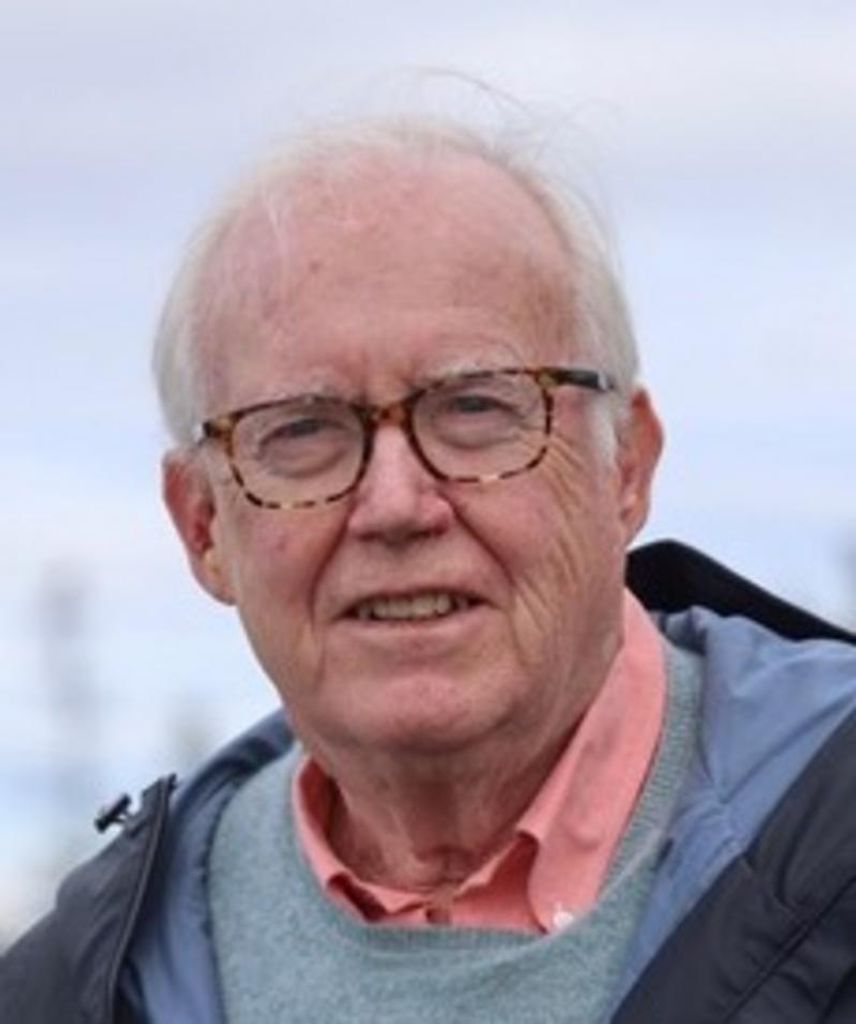
Bruce
d. Apr 10, 2026
Robert Rockwell Bruce's Obituary
Robert Rockwell Bruce, who moved with his family to Hanover in 2003 to be closer to his nonagenarian mother and to immerse himself in small-town life after fast-paced decades traveling the globe as an international telecommunications lawyer, died April 10. He was 82.
Setting aside his pinstripe suits, the uniform of his distinguished legal career, and donning his favored well-worn khakis, Bob embraced new opportunities in retirement. When asked what he was up to, he liked to say, "I'm perfecting the art of doing nothing." But that was just a tease.
Soon after arriving in Hanover, he joined the Center for Digital Strategies at the Tuck School of Business as a research fellow, investigating the state of cyber security for the World Bank. Wanting to contribute to the civic life of the town, he ran for the Hanover/Dresden School Board and, to his delight, won a rare contested seat, eventually becoming board chairman — one of the most challenging positions he said he'd ever had.
Bob helped E.C. Fiber expand internet access to the rural reaches of the Upper Valley and advised CATV8, the public access channel. He joined in the effort to conserve Hanover's Pine Park and happily solicited donations for the Hanover Rotary, ringing the Christmas bells with his beloved golden retriever by his side. A wave-energy project, the brainchild of a local inventor, represented a wholly new pursuit that engaged and fascinated him.
Bob also spent considerable time perfecting his elegant forehand, triumphant whenever he bested his strapping offspring on the tennis court.
Though very much an urban animal who spent his formative years in the Riverdale neighborhood of the Bronx and who reveled in the sights and sounds of bustling cities, Bob acclimated easily to life in a college town, never regretting his decision to move to Hanover. His last decade afforded time to read voraciously, reflect, and remonstrate against political trends he feared would threaten democratic institutions and the future of the republic.
Bob spent the bulk of his professional life as a partner in the New York-based international law firm Debevoise & Plimpton (1983 to 2003), where he focused mainly on telecommunications law, policy and regulation, becoming among the most highly regarded experts in his field.
In 1993, he relocated from Washington, D.C., to London to chair the firm's international telecommunications practice, a role that required extensive travel throughout Europe and around the world. He was a lead player in establishing regulatory frameworks in the communications sector in Europe, Latin American and Asia and in privatizing numerous state-owned European telecommunications companies.
Public and government service, which Bob highly valued, preceded his work in private practice. After graduating from a joint degree program in law and public policy at Harvard University (1970), where he'd also been an undergraduate, he joined an anti-poverty program in Appalachia. Shortly thereafter he became the first Director of Communications Planning at the nascent Public Broadcasting Service. Typical of Bob's capacity for innovative thinking, he and a colleague conceived "the electronic box office" to expand access to the arts. Call it the precursor to "Lincoln Center Live" and other live arts broadcasts. He also helped set the stage for educational programming to allow shows such as "Sesame Street" to be shared and distributed nationwide.
At the young age of 33, Bob was tapped to serve as General Counsel of the Federal Communications Commission during the Carter Administration (1977-1981). Leading a team of lawyers, Bob was instrumental in the deregulation of telecommunications (including the breakup of AT&T's monopoly) and helped to usher in the highly competitive telecom environment that unleashed innovation and the internet services that changed modern communication. It is no exaggeration to say that Bob was at the very center of that effort, providing intellectual capital and identifying the legal authority to defend the deregulatory framework he helped conceptualize.
Later on, with a glint in his eye, he liked to say that he (not Al Gore!) invented the internet.
Two books Bob co-authored in the 1980s about international telecom regulations, which documented the rapid changes in telephony worldwide, were seminal in his field and solidified his reputation as an important thought leader. He was a frequent advisor to national governments as well as to institutions such as the World Bank.
Highlights of Bob's career, however, cannot capture the man in full: the dutiful son who cared many years for his aging mother; the devoted father of three; the loving husband; the loyal friend and mentor; the talented photographer; the man at ease who refused to wear blue jeans; the avid traveler who reveled in meeting people—cabbies as well as clients—around the world, whether in Berlin, Brasilia or Beijing.
Bob was modest yet erudite, cautious but ever keen to explore. He had a curious and capacious mind—a mind his family treasured. And while he often described himself as exhibiting an "Episcopalian reserve," his warmth, wry wit, and wisdom were apparent to all who knew him.
Robert Bruce is survived by his wife, Kathryn Stearns; his children Dr. Benjamin Bruce (Dana Christine Bruce) of Hinsdale, Il,; Hannah Bruce Huey (Daniel Huey) of Washington, D.C.; and S. David Bruce of Seattle; and by five grandchildren, Brayden, Jackson, and Madeline Bruce; and Henry and Oliver Huey. And by his golden retriever, Maisie.
Robert Rockwell Bruce's Guestbook

Visits: 340
This site is protected by reCAPTCHA and the
Google Privacy Policy and Terms of Service apply.
Service map data © OpenStreetMap contributors